
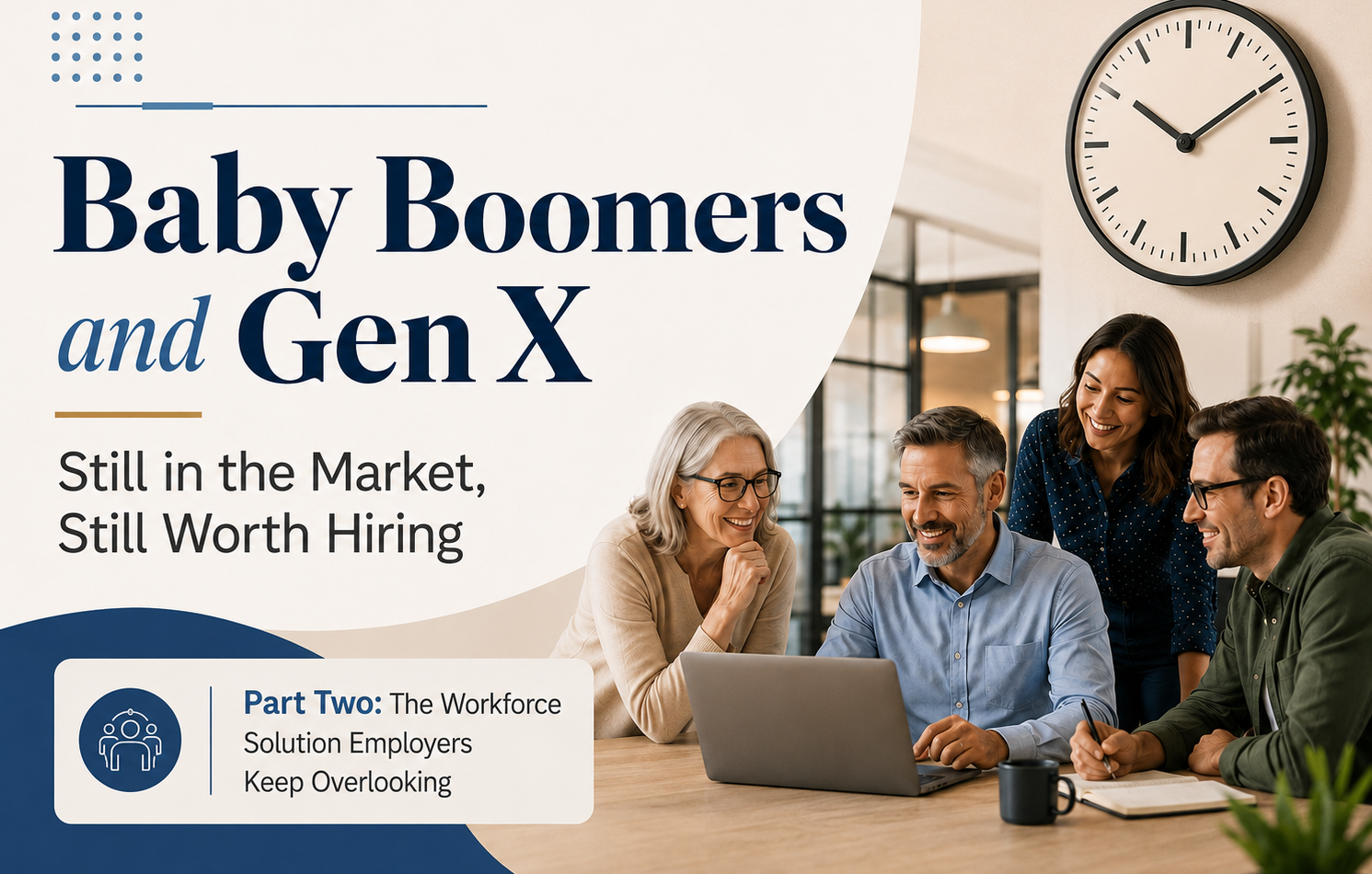
Part Two: The Experienced Workforce Right Under Our Noses
In Part One, I wrote about Baby Boomers and Gen Xers who are still employed, still interested in staying active professionally, or thinking differently about what a career can look like in the next stage of life. Now I want to talk about what employers can actually do with that, because maybe the conversation is not just about hiring experienced candidates. Maybe it is also about retaining the seasoned employees we already have and thinking more creatively about how to use their knowledge before they walk out the door.
Experienced does not automatically mean stuck in the past. It can mean steady, practical, adaptable, and communicative, with a clear sense of what is effective, what is not, and what tends to fall through the cracks.
Not every seasoned professional wants a full-time, high-pressure job. Some want part-time hours. Some want project-based opportunities. Some want flexibility. Some want purpose. Some want to stay connected without carrying the whole load. That can still be incredibly useful.
Here are five ways employers can engage Baby Boomers and Gen Xers more effectively.
1. Create part-time or semi-retired roles
Many experienced workers would be happy to work part-time, seasonally, or on a more flexible schedule. They may not need the same benefit package as a full-time employee or be looking for constant advancement. And if they have the opportunity to work in a way that fits their current lifestyle, they may be more engaged during the time they are there.
Employers could consider roles such as:
- Part-time administrative or office support
- Customer follow-up and relationship management
- Seasonal, weekend, or project-based coverage
The key is simple: stop assuming that part-time means less committed. Sometimes it means focused, steady, and exactly what the business needs.
2. Use experienced workers as mentors
A lot of workplace specific knowledge and general professional prowess is not written down anywhere. It resides within the people who have been doing the work for years.
These individuals know how to handle a difficult customer and when a problem is about to become bigger. Experienced workers often bring a practical kind of judgment that is hard to teach. They have learned which details matter, how to steady a stressful situation, and when a real conversation is better than one more email.
Employers could use experienced workers as:
- Mentors for new hires
- Training partners for younger staff
- Guides for workplace expectations, customer service, and communication
This does not have to be a formal program with binders and checklists. It can be as simple as pairing a newer employee with someone who has been around long enough to understand and explain how the work really happens.
That is how knowledge gets passed on.
3. Bring them in as facilitators and connectors
Some people are just good at helping a conversation get unstuck. After years of meetings, customer conversations, workplace conflict, committees, and change, they often know how to read the room, notice when people are frustrated or confused, and help move things forward.
Employers could use experienced workers as:
- Meeting or training facilitators
- Onboarding guides for new employees
- Community, client, or internal communication connectors
Sometimes organizations do not need one more system. They need someone who can help people understand each other, and that is where perspective can be incredibly useful.
4. Let them strengthen written and oral communication
With AI becoming part of the workplace, communication skills may matter more than ever. Not all Baby Boomers shy away from AI; many are using it, learning it, and also recognizing the need for human review. AI can help draft an email, proposal, script, or presentation, but someone still needs to know whether the message sounds right. Is it too harsh? Too vague? Too cold? Too wordy? Did it miss the point entirely? That is where seasoned workers can be incredibly useful, especially when they have spent years talking with customers, staff, clients, vendors, or the community.
Employers could use this kind of support for:
- Customer emails, phone scripts, and client communication
- Training materials, policy explanations, and internal updates
- Proposals, presentations, donor letters, or community messaging
Younger workers may be faster with the tools, but seasoned workers can help ensure the message actually says what it needs to say.
5. Create project-based or advisory roles
Project-based work can be a good fit for those workers who still want to contribute, but may not want to step back into a traditional full-time role. A clear project, timeline, and outcome can give employers focused support while allowing the individual to bring fresh energy to something specific and useful.
Seasoned workers can be a great fit for roles such as:
- Project advisor for a transition, expansion, or cleanup effort
- Process reviewer to document procedures and improve workflow
- Short-term consultant for customer service, operations, or staff training
For small businesses and nonprofits, this can be a smart way to get the much-needed support without adding a full-time senior-level position, and the impact can last long after the project ends.
A workforce solution hiding in plain sight
If employers are serious about solving staffing challenges, they may need to look beyond the traditional job posting and think more creatively about the people already within reach. There is a workforce of experienced people who may not want the same kind of work they wanted twenty years ago, but who still have a lot to offer through part-time roles, mentoring, project-based opportunities, communication support, or a seat at the table without having to run the whole table.
That does not make them less valuable. It may make them exactly what many workplaces need. Maybe the real question is not whether experienced workers are still relevant, but whether employers are willing to tap into their knowledge, perspective, and skills well.
Last modified: June 10, 2026